MLOps Certified Professional (MLOCP): Unlocking the Power of Production-Ready Machine Learning
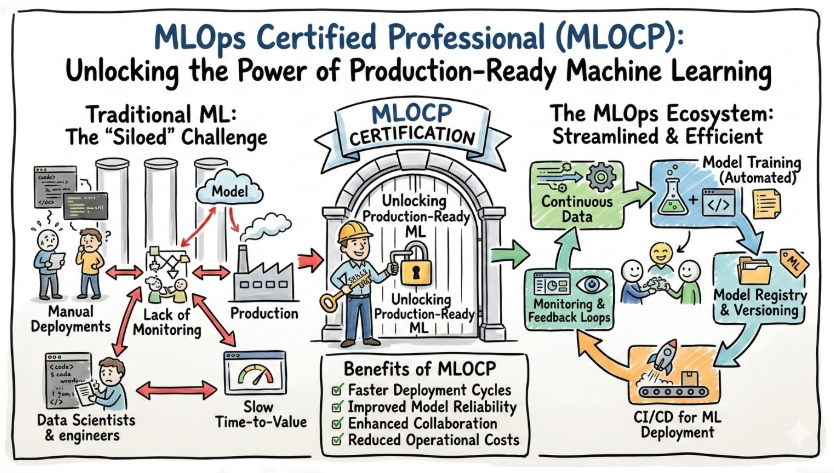
There is a specific kind of silence that happens in a boardroom when a multi-million dollar AI project fails to make it into production. It’s not the silence of a mistake; it’s the silence of realized complexity. Over the years, I have watched the tech industry grapple with different versions of this same problem. We saw it with early web applications, then with big data, and now, we are seeing it with Machine Learning.
The hard truth is that building a model is no longer the "hard" part. With the tools available today, any competent data scientist can train a high-performing model in a matter of weeks. The real challenge—the one that keeps CTOs awake—is how to keep that model running reliably, how to update it without breaking the system, and how to ensure it actually delivers business value at scale. This is the "industrialization" phase of AI, and the MLOps Certified Professional (MLOCP) is the blueprint for mastering it.
The Shift Toward Engineering Rigor
Machine Learning is currently moving out of its "craftsman" phase. We are moving away from bespoke, manual processes and toward a factory-like discipline. If you’ve spent time in software architecture or systems engineering, you know that the only way to handle complexity is through rigor and automation.
The MLOps Certified Professional (MLOCP) is not just a certification about tools. It is a certification about a new way of thinking. It treats Machine Learning not as a series of experiments, but as a living, breathing software product that requires a lifecycle, a heartbeat, and a safety net.
Comparing MLOps Maturity: The MLOCP Standard vs. Traditional Approaches
To understand the value of this certification, one must look at how it transforms the standard, often "fragile" workflow into a resilient, production-grade system.
| Capability | The Traditional ML "Craftsman" Way | The MLOCP "Industrial" Standard |
| Model Deployment | Manual, ticket-based handoffs. | Fully automated CI/CD/CD pipelines. |
| Reproducibility | "It worked on my laptop" syndrome. | Strict versioning of code, data, and models. |
| Scalability | Vertical scaling, manual server setup. | Kubernetes-native, horizontal auto-scaling. |
| Monitoring | Checking logs once a week. | Real-time drift and performance observability. |
| Data Integrity | Static CSVs and manual cleanup. | Automated data pipelines and lineage tracking. |
| Testing | Unit tests for code only. | Holistic tests for data, models, and systems. |
A Deep Dive into the MLOCP Curriculum: Building the "AI Factory"
When we look at what makes an engineer effective in the modern era, it’s their ability to see the whole system. The MLOCP course, offered by DevOpsSchool, is built on this systemic perspective. It doesn't just teach you how to "use" a tool; it teaches you how to build an ecosystem.
1. The Infrastructure Layer: The Groundwork of AI
Every great skyscraper needs a foundation. In MLOps, that foundation is Linux and Cloud-native infrastructure. The course ensures that you aren't just a user of the cloud, but a master of it. You will learn how to configure environments that are repeatable and secure, ensuring that your ML models have a stable home.
2. The Packaging Layer: Docker and the Art of Containers
If you can’t package it, you can’t ship it. The MLOCP program dives deep into containerization. You will learn how to wrap complex ML dependencies into Docker images that run the same way in testing as they do in production. This eliminates the "dependency hell" that often kills AI projects during deployment.
3. The Orchestration Layer: Kubernetes and Scaling
Running one model is easy. Running five hundred models, all with different resource requirements, is a nightmare without orchestration. You will master Kubernetes—the gold standard for managing containers at scale. This allows your organization to handle massive traffic spikes without manual intervention.
4. The Automation Layer: Pipelines with Airflow and Kubeflow
This is where the magic happens. The MLOCP course teaches you how to build "pipelines"—automated highways for data. Using tools like Apache Airflow and Kubeflow, you will learn to automate the entire journey from raw data ingestion to model deployment. This reduces the time-to-market from months to hours.
5. The Observability Layer: Maintaining the Heartbeat
In production, a model is a liability if you aren't watching it. The curriculum covers advanced monitoring using Prometheus and Grafana. You’ll learn how to detect "Model Drift"—the silent killer where a model becomes less accurate over time because the world changed. Knowing how to set up automated alerts for these issues is what separates a junior engineer from a senior architect.
The Provider: Why DevOpsSchool Matters
In a sea of generic training platforms, DevOpsSchool stands out because of its heritage. They didn't start as a marketing company; they started as a technical community.
- Rooted in Experience: The course design is influenced by veterans like Rajesh Kumar, who have been in the trenches of DevOps long before it was a buzzword. This means the lessons are practical, not just theoretical.
- Global Footprint: With a presence that spans from the tech hubs of India (Bangalore, Hyderabad, Delhi) to international markets, they understand the global standards required by top-tier MNCs.
- Community and Mentorship: You aren't just buying a login to a portal. You are joining an ecosystem of practitioners. The mentorship provided is aimed at solving real-world problems, not just passing a test.
Career Impact: Why the Market is Hungry for MLOCP Professionals
If you look at the job boards today, you’ll see a massive surplus of people who know how to build a model in Python. However, there is a severe shortage of people who know how to engineer that model into a product.
For Software Engineers:This certification is your ticket out of the "standard" feature-building cycle and into the high-stakes world of AI Engineering. It gives you the specialized skills that command premium salaries and leadership roles.
For Managers and Architects:Understanding the MLOCP framework allows you to build teams that actually deliver. It gives you the vocabulary to bridge the gap between your data science team and your infrastructure team, reducing friction and increasing the ROI of your AI investments.
The Global Perspective:Whether you are working for a startup in Silicon Valley or a tech giant in Bangalore, the challenges of MLOps are the same. A certification like MLOCP provides a standardized language that is recognized across borders, making you a mobile and highly valuable asset in the global economy.
The "Fragility" Trap: Common MLOps Failures
Many companies try to do MLOps "on the cheap" or without a plan. Having seen these failures firsthand, I can tell you they almost always fall into the same traps.
The biggest issue is the "Manual Deployment Gap." This is when a model is finished, but it takes three weeks for the DevOps team to figure out how to put it into a server because they don't understand the model's requirements. This delay often makes the model obsolete before it even goes live.
Other common pitfalls include:
- Data Leakage in Pipelines: Failing to separate training and testing data properly in an automated flow.
- Lack of Version Control for Data: Knowing the code version but having no idea what version of the dataset was used to train it.
- Ignoring the "Feedback Loop": Not building a way for production data to flow back into the training phase for continuous improvement.
- Security as an Afterthought: Allowing sensitive data to move through pipelines without proper encryption or access controls.
The MLOCP course is designed to be a "preventative medicine" for these issues, teaching you the best practices to avoid these costly mistakes from day one.
Who Should Enroll in the MLOCP Course?
This program is intensive and is designed for those who want to be at the top 1% of the field. It is best suited for:
- DevOps and SRE Professionals: Who want to pivot their infrastructure expertise toward the most exciting growth area in tech.
- Data Scientists: Who want to gain independence and learn how to deploy their own models without waiting for an engineering team.
- Full-Stack and Backend Developers: Who want to specialize in AI-driven applications.
- Cloud Architects: Who need to design the complex environments required for distributed machine learning.
- Engineering Managers: Who need to understand the lifecycle of AI to effectively manage budgets and timelines.
Frequently Asked Questions (FAQs)
Q: Is the MLOCP certification recognized by major employers?A: Yes. DevOpsSchool is a recognized leader in the space, and their certifications are held by employees at top global consulting and product firms.
Q: What tools will I actually learn?
A: The course is tool-rich, covering Docker, Kubernetes, Git, DVC, MLflow, Airflow, Kubeflow, Prometheus, and Grafana, among others.
Q: How does this differ from a Data Science certification?
A: A Data Science certificate focuses on what the model is (math, algorithms). MLOCP focuses on how the model lives (deployment, scaling, monitoring).
Q: Is there post-training support?
A: DevOpsSchool is known for its community support, offering lifetime access to course materials and a network of professionals to help you navigate your career.
Conclusion: Engineering the Future
We are past the point where AI is a luxury. It is now a core requirement for any business that wants to survive. But as the stakes get higher, the tolerance for "experimental" and "unreliable" systems is disappearing.
The MLOps Certified Professional (MLOCP) is your opportunity to step into a leadership role in this new era. It’s about moving beyond the code and understanding the system. It’s about building AI that doesn't just work in a demo, but works in the real world, under real pressure, for real users.If you are ready to stop being a spectator and start being an architect of the AI revolution, now is the time to act.
Take the next step in your professional journey:Enroll in the MLOps Certified Professional (MLOCP) Course at DevOpsSchool
