Certified DevOps Architect: Bridging the Gap Between Code and Strategy
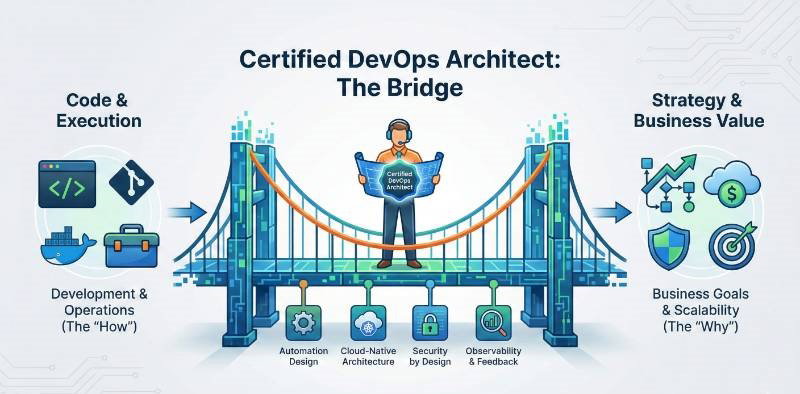
In the rapidly shifting landscape of modern technology, the way we conceptualize, build, and deliver software has undergone a permanent transformation. Gone are the days when a clear, physical wall existed between developers who wrote code and the operations teams who managed servers. DevOps arrived to tear down those walls, but as our digital ecosystems have grown into massive webs of microservices, server less functions, and globally distributed clusters, the "practitioner" level is no longer sufficient for enterprise success. The industry is currently facing a "complexity crisis." Knowing how to script a Jenkins pipeline or push a Docker image is basic literacy; the real challenge lies in designing the entire lifecycle to be secure, cost-effective, and infinitely scalable. This is the domain of the architect. Deciding to become a Certified DevOps Architect is more than just adding a title to your LinkedIn—it is a commitment to mastering the "why" behind the tools and the "how" of sustainable systems design.
The Shift from Engineer to Architect: A Mindset Evolution
Most careers in this space begin with technical execution. As an engineer, your primary concern is the "How": How do I fix this bug? How do I automate this deployment? You are focused on the immediate task at hand. However, as you transition into an architect’s role, your focus shifts toward strategy and foresight. An architect doesn't just ask which tool to use; they ask how a specific tool choice impacts the long-term security posture of the organization. They evaluate how a deployment strategy will affect the quarterly cloud budget and whether the infrastructure can withstand a 10x spike in traffic without human intervention. This evolution requires a deep understanding of several moving parts, including Infrastructure as Code (IaC), Continuous Integration and Deployment (CI/CD), and Site Reliability Engineering (SRE).The Certified DevOps Architect program is specifically engineered to facilitate this mindset shift. It provides the intellectual and technical framework needed to stop merely building "pipelines" and start designing resilient "products" that serve the business and the end-user simultaneously.
A Deep Dive into the Architectural Learning Path
A professional-level certification must offer more than a badge; it must offer a new lens through which to view technology. The curriculum for this certification is structured around the four critical pillars of modern software delivery.
1. Designing for Strategic Automation (GitOps)
Automation is the heartbeat of DevOps, but automation without design is simply a way to make mistakes faster. At the architect level, you move toward "Declarative Automation." This section of the course focuses on GitOps—the practice of using Git as the single source of truth for your entire infrastructure. You will learn to design systems where the "Desired State" is defined in code, and automated controllers work tirelessly to ensure the "Actual State" matches it. This reduces human error and provides an immutable audit trail for every change made to the system.
2. Cloud-Native Architecture and Kubernetes Orchestration
While "moving to the cloud" was the goal of the last decade, "optimizing for the cloud" is the goal of today. Architects must understand the nuances between public, private, and hybrid cloud models to avoid vendor lock-in and excessive costs. A major focus here is Kubernetes—not just as a place to run containers, but as a sophisticated orchestration platform. You will dive into service meshes, ingress controllers, and persistent storage strategies, ensuring that your applications are not just "running" but are truly cloud-native and self-healing.
3. Security by Design: The DevSecOps Mandate
In the modern threat landscape, security is no longer a checkbox at the end of a project; it is the foundation. An architect’s responsibility is to weave security into the very fabric of the CI/CD pipeline. This involves implementing "Shift Left" strategies where security scans, dependency checks, and compliance audits are automated and triggered with every code commit. You will learn how to manage secrets securely, implement Zero Trust networking, and ensure that your architecture protects data at rest and in transit.
4. Advanced Observability and Feedback Loops
You cannot manage—or fix—what you cannot see. High-level architecture requires sophisticated monitoring, logging, and tracing. This course teaches you how to build "Observability" into your systems from day one. By understanding how to gather telemetry from production and funnel that data back into the development cycle, an architect ensures that the system is in a state of continuous improvement. This reduces "Mean Time to Recovery" (MTTR) and keeps the focus on the user experience.
Why the Provider Matters: DevOpsSchool
In an era of 15-minute YouTube tutorials and superficial "crash courses," the source of your education determines the value of your credentials. DevOpsSchool has earned its reputation by prioritizing the human element of technical training. They recognize that a professional’s time is valuable, and their learning should be applicable the moment they return to their workstation. The credibility of DevOpsSchool is rooted in real-world experience. Their instructors, including veterans like Rajesh Kumar, don't just teach theory; they share the "battle scars" from years of managing enterprise environments. This provider offers a level of depth that is rare in the industry:
- Immersive Hands-on Labs: Theory is validated through practice in sandboxed environments that mirror real-world production clusters.
- Mentor-Led Guidance: You aren't just a number in a database. You have access to experts who can help you navigate the specific "what if" scenarios that arise in complex enterprise setups.
- Community and Lifetime Support: The tech stack of 2026 will look different from the tech stack of 2030. DevOpsSchool provides lifetime access to materials and a thriving community of peers, ensuring you stay ahead of the curve as the industry evolves.
Career Benefits and the ROI of Architectural Mastery
The demand for architects has reached an all-time high because the cost of "bad architecture" has become too high for businesses to ignore.
- Command Higher Compensation: Because an architect’s decisions directly impact cloud costs, security risks, and speed-to-market, they are among the highest-paid professionals in the global IT sector.
- Access to Leadership Roles: This certification is a bridge to roles like Principal DevOps Engineer, Cloud Architect, or Chief Technology Officer (CTO). It gives you the vocabulary to speak to both the "engine room" (developers) and the "boardroom" (executives).
- Future-Proof Skillsets: Tools and frameworks are transient. Today it might be Terraform or Prometheus; tomorrow it might be something new. However, the principles of reliability, security, and scalability are eternal. By mastering these architectural concepts, you ensure your value remains high regardless of which tool is currently in fashion.
Who Should Enroll?
This is a high-level course designed for those who have already mastered the basics and are hungry for more responsibility. It is ideal for:
- Senior Software Engineers who want to master the environment where their code lives.
- Systems Administrators looking to pivot from manual infrastructure management to automated, cloud-scale architecture.
- DevOps Engineers who have spent years in the "trenches" and are ready to take a seat at the design table.
- IT Managers who need the technical depth to lead teams through massive digital transformations.
Conclusion
The journey from technical execution to architectural design is the most rewarding leap a tech professional can make. It is a transition from following a roadmap to being the one who draws it. As systems grow more complex and the stakes of software delivery continue to rise, the world needs architects who can see through the noise and build something that lasts.By investing in high-level strategy and technical proficiency, you aren't just getting a certificate; you are becoming an indispensable asset to any organization. You become the person who ensures that innovation doesn't come at the cost of stability.If you are ready to take control of your career and lead the next wave of technological innovation, the first step is clear. You can explore the full curriculum and join the next cohort by visiting the provider at DevOpsSchool .The blueprint for your future starts here. Master the design, lead the change, and become the architect your industry demands.
