Master Modern IT with AIOps Certification Training
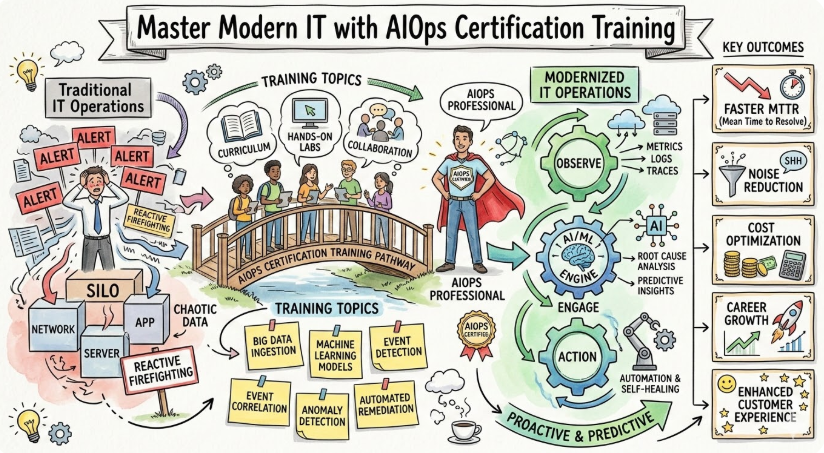
The world of IT operations is changing faster than most people can keep up with. A decade ago, we were worried about managing a few dozen physical servers. Then came virtualization, then the cloud, and now we are dealing with microservices, serverless functions, and thousands of containers running across multiple global regions. For an engineer or a manager sitting in the middle of this, the reality is clear: the old ways of watching dashboards and waiting for an alert to fire are no longer enough.
We are currently drowning in data but starving for insights. Every part of a modern system generates logs, metrics, and traces. When something goes wrong, you don’t just get one alert; you get a thousand. This "alert fatigue" is burning out talented engineers and costing businesses millions in downtime. This is where Artificial Intelligence for IT Operations (AIOps) moves from being a buzzword to a necessity.
If you want to stay relevant in this field, you have to understand how to apply machine learning and data science to the operational side of software. Taking an AIOps Certification Training Course is no longer just an "extra" item on a resume; it is the blueprint for how we will manage systems for the next decade. This article explores why this shift is happening, how you can navigate it, and why getting certified is the best move for your career right now.
Understanding the Shift: Why AIOps?
To understand the value of a certification, we first have to understand the problem it solves. Traditional monitoring is reactive. You set a threshold—say, 80% CPU usage—and when the system hits that mark, it sends an email. But in a complex environment, that 80% might be perfectly normal during a batch job, or it might be a symptom of a much deeper memory leak that started three hours ago.
AIOps changes the game by using algorithms to find patterns that a human eye simply cannot see. It looks at the historical behavior of your infrastructure and says, "This looks like the start of a database failure we saw last month," before the database actually crashes. It filters out the noise, correlates related events, and helps you focus on the root cause rather than the symptoms.
Quick Comparison: Traditional Ops vs. AIOps
| Feature | Traditional Operations | AIOps-Driven Operations |
| Data Handling | Manual analysis of logs and metrics | Automated ingestion and correlation |
| Issue Detection | Threshold-based (Reactive) | Anomaly-based (Proactive) |
| Alerting | High noise and alert fatigue | Intelligent noise reduction and grouping |
| Root Cause | Manual "war rooms" and searching | Automated root cause identification |
| Scalability | Hard to scale with human headcount | Scales effortlessly with data volume |
| Resolution | Manual scripts and intervention | Automated remediation (Self-healing) |
A Deep Dive into the AIOps Certification Training Course
When looking for a training program, it is important to find one that doesn't just teach theory. You don't need a math lecture; you need to know how to fix a production outage using AI. The AIOps Certification Training Course is designed to bridge the gap between data science and system administration.
What the Course Covers
The curriculum usually starts with the basics of data collection. You cannot have AI without good data. You’ll learn how to pull information from various sources—APIs, logs, cloud providers, and performance monitors—into a centralized data lake.From there, the course moves into the "intelligence" phase. This involves learning about:
- Pattern Discovery: How to use machine learning to identify what "normal" looks like for your specific application.
- Anomaly Detection: Setting up systems that can spot a deviation from the norm without manual tuning.
- Causal Analysis: Moving beyond correlation to understand what actually triggered an event.
- Automation: Integrating these insights into tools like Ansible, Terraform, or Kubernetes to fix problems automatically.
The Benefits of Learning AIOps
The primary benefit is efficiency. For an engineer, it means fewer 3:00 AM wake-up calls. For a manager, it means a higher Service Level Objective (SLO) and a happier team. By mastering these tools, you become the person who saves the company time and money. You move away from being a "firefighter" and start acting like an "architect."
Learning from the Best: DevOpsSchool
In the world of technical training, credibility is everything. There are many platforms out there, but DevOpsSchool has built a reputation for being deeply rooted in the community. They don't just provide videos; they provide a roadmap.
With a presence in India and a growing global footprint, DevOpsSchool has spent years refining how they teach complex subjects like SRE and DevSecOps. Their approach is led by industry veterans who have spent decades in the trenches. When you enroll in their AIOps Certification Training Course, you aren't just getting a certificate; you are gaining access to a methodology that has been tested in real-world corporate environments.
The instructors understand the challenges of modern software delivery. They focus on practical labs and real-life scenarios. This is vital because, in AIOps, the theory is only about 20% of the battle. The other 80% is knowing how to handle messy, incomplete data and turning it into something useful.
Career Benefits and Real-World Value
The job market is currently going through a massive "upskilling" phase. Companies are no longer looking for people who can just write a Bash script. They want professionals who understand the intersection of software, infrastructure, and intelligence.
- Increased Marketability: Having "AIOps" on your profile immediately sets you apart from the sea of standard DevOps engineers. It shows you are looking ahead, not behind.
- Higher Salary Potential: Specialist roles in AIOps often command a significant premium because the skill set is rare. Companies are willing to pay for the ability to reduce downtime.
- Future-Proofing Your Role: As automation becomes more prevalent, basic administrative tasks will be handled by machines. The humans who manage those machines will be the ones who remain indispensable.
- Leadership Opportunities: For managers, understanding AIOps allows you to lead digital transformation projects. You can speak the language of both the C-suite (cost savings) and the engineering team (tooling).
Common Mistakes People Make When Moving to AIOps
Many organizations and engineers jump into AIOps with the wrong mindset. They treat it like a magic wand that will solve all their problems overnight. This is a recipe for failure. The biggest mistake is ignoring the quality of your data. AI is only as good as the information you give it. If your logs are messy and your metrics are inconsistent, your AI will give you "garbage" insights.
Another common error is trying to automate everything at once. This leads to "automation loops" where the AI makes a change, the system reacts, and the AI makes another change, causing a spiral of instability.
Key Pitfalls to Avoid:
- Treating AI as a "Black Box": If you don't understand why the AI made a decision, you can't trust it during a critical outage.
- Neglecting Cultural Change: AIOps requires collaboration between Data Scientists and DevOps teams. If they stay in silos, the project will fail.
- Over-reliance on Tools: Don't just buy a shiny new tool and expect it to work. You need a strategy and trained people to run it.
- Skipping the Basics: You cannot do AIOps if you haven't mastered basic monitoring and observability first.
Who Should Enroll in This Course?
This course is not just for one specific type of person. Because AIOps touches so many parts of the business, it is valuable for various roles:
- Software Engineers: If you want to understand how your code behaves in production and how to build more resilient systems.
- DevOps and SRE Professionals: This is the natural next step in your career progression. It’s "SRE 2.0."
- IT Managers and Directors: To understand how to budget for and implement intelligence-driven operations in your organization.
- Data Scientists: Who want to pivot into the operational side of tech and see how their models can impact system uptime.
- Cloud Architects: To design infrastructure that is inherently observable and ready for AI integration.
Frequently Asked Questions (FAQs)
Q: Do I need to be a math expert to learn AIOps?
A: No. While understanding the basics of how algorithms work is helpful, the course focuses on the application of these tools in an IT environment, not the complex calculus behind them.
Q: Is AIOps going to replace DevOps engineers?
A: Not at all. It is a tool that makes DevOps engineers more powerful. It removes the boring, repetitive tasks so you can focus on high-level architecture and problem-solving.
Q: How long does the certification take?
A: It depends on your pace, but most professionals find that they can complete the training and feel confident in their skills within a few weeks of dedicated study and lab work
Q: Why choose DevOpsSchool specifically?
A: They offer a blend of technical depth and practical experience that is hard to find elsewhere. Their focus on the "human" side of learning—mentorship and community—makes a big difference.
Q: Can I take this course if I’m just starting my career?
A: It is helpful to have a basic understanding of Linux, cloud concepts, and at least one programming language. If you are a total beginner, you might want to start with a foundational DevOps course first.
Conclusion: Taking the Next Step
The transition to AIOps is inevitable. As our systems grow more complex, the gap between what a human can manage and what the system requires is only getting wider. You can either wait for the shift to happen and try to catch up, or you can lead the way.
Enrolling in an AIOps Certification Training Course is an investment in your future. It gives you the vocabulary, the tools, and the confidence to handle the challenges of modern infrastructure. Whether you are looking to secure a promotion, move into a new role, or simply make your daily work life less stressful, this is the path forward.Don't let the complexity of the future hold you back. Start mastering the tools of tomorrow, today. By choosing a provider like DevOpsSchool, you are ensuring that your education is grounded in reality and backed by experts who care about your success. The era of intelligent operations is here—make sure you are a part of it.