Master in DevOps Engineering: A Complete Training Overview
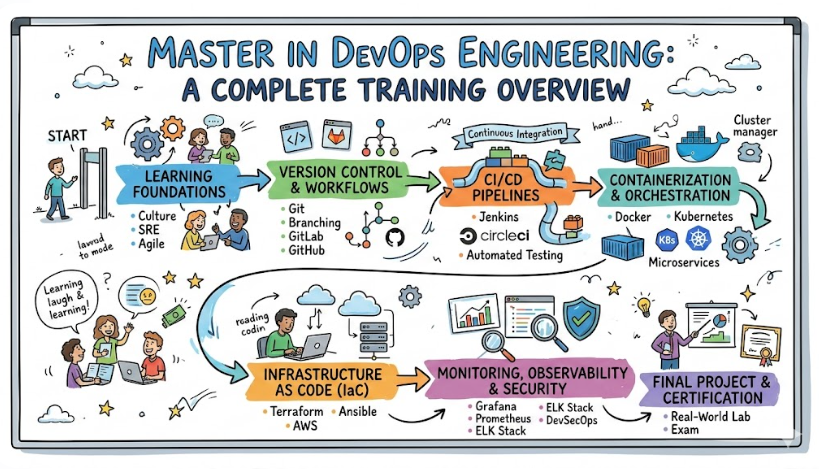
The landscape of software development has undergone a seismic shift. We are no longer in an era where "it works on my machine" is an acceptable excuse, nor can we afford the wall of silence that traditionally existed between developers and operations teams. Having navigated the evolution of infrastructure from physical data centers to virtualized environments and now to cloud-native microservices, I have seen firsthand that the most successful organizations are those that treat their infrastructure as code and their delivery pipeline as a product. However, the transition to a true DevOps culture is often misunderstood. It is frequently reduced to a set of tools—Jenkins, Docker, or Kubernetes—when in reality, it is a fundamental shift in how we deliver value. For engineers and managers looking to lead this shift, specialized training is no longer optional; it is a prerequisite. This brings us to the Master in DevOps Engineering program, a comprehensive curriculum designed to bridge the gap between legacy practices and modern high-velocity delivery.
The State of DevOps: Why Mastery Matters
In the current market, "DevOps" has become a catch-all term. We see job descriptions that ask for a "DevOps Engineer" who is essentially a Sys Admin with a different title, or a Developer who knows how to write a Docker file. True mastery, however, involves understanding the entire lifecycle: from the first line of code to the automated monitoring of a production environment. The importance of the Master in DevOps Engineering course lies in its ability to synthesize these disparate skills into a cohesive framework. It isn't just about learning how to use a tool; it’s about understanding the "why" behind the automation. It’s about reducing toil, increasing deployment frequency, and ensuring that security is baked into the pipeline from the start rather than bolted on at the end.
| Feature | Traditional Engineering | Master in DevOps Engineering Approach |
| Deployment Frequency | Monthly or Quarterly | On-demand (Multiple times a day) |
| Infrastructure | Manual Provisioning | Infrastructure as Code (IaC) |
| Feedback Loop | Slow (Weeks/Months) | Real-time (Minutes) |
| Security | Final Stage Gate | Integrated (DevSecOps) |
| Recovery | Manual & High Risk | Automated & Low MTTR |
| Collaboration | Siloed Departments | Cross-functional Teams |
Deep Dive: What the Master in DevOps Engineering Entails
A "Master" level program implies a depth that goes beyond the surface. This isn't a weekend bootcamp; it is a rigorous exploration of the modern tech stack. The course is structured to take a practitioner through the following core pillars:
1. Version Control and Collaborative Workflows
Everything starts with the code. Mastery begins with Git—not just basic commits, but complex branching strategies (Git Flow, Trunk-based development), merge conflict resolution, and hooks that trigger the initial stages of the CI/CD pipeline.
2. Continuous Integration and Continuous Delivery (CI/CD)
The heartbeat of DevOps is the pipeline. This program focuses heavily on tools like Jenkins, GitLab CI, and Azure DevOps. The goal is to move from manual builds to a fully automated system where every code change is tested, built, and ready for deployment without human intervention.
3. Containerization and Orchestration
Understanding Docker is a baseline requirement today, but managing containers at scale is where the "Master" level skills come in. The curriculum dives deep into Kubernetes (K8s), covering everything from Pods and Services to Helm charts and Service Meshes (like Istio). This is critical for engineers managing distributed systems across global clusters.
4. Infrastructure as Code (IaC) and Configuration Management
Gone are the days of manual server configuration. The course emphasizes Terraform and Ansible. You learn to treat your servers like cattle, not pets—meaning you can destroy and recreate an entire environment in minutes using version-controlled scripts.
5. Monitoring, Logging, and Observability
You cannot manage what you cannot measure. The program covers the "Golden Signals" of monitoring using Prometheus and Grafana, alongside centralized logging with the ELK stack (Elasticsearch, Logstash, Kibana). The focus here is on proactive SRE (Site Reliability Engineering) principles to maintain 99.99% uptime.
Why Choose DevOpsSchool ?

When selecting a certification provider, credibility is everything. DevOpsSchool has established itself as a premier destination for technical training, specifically within the Indian and global DevOps communities. What sets them apart is their faculty. The trainers, led by industry veterans like Rajesh Kumar, bring real-world scenarios into the classroom. They don't just teach from a slide deck; they share the scars and successes of managing production environments for Fortune 500 companies. This practical, "in-the-trenches" knowledge is what transforms a student into a practitioner. DevOpsSchool’s reputation is built on:
- Hands-on Labs: The focus is on doing, not just watching. You spend more time in a terminal than in a textbook.
- Updated Curriculum: The world of DevOps moves fast. Their content is constantly refreshed to reflect the latest versions of tools and industry trends.
- Community Support: Access to a vast network of alumni and experts who help troubleshoot real-world problems long after the course ends.
Career Benefits and Real-World Value
The return on investment (ROI) for a Master in DevOps Engineering is visible in both salary and job security. For Software Engineers, this course is the bridge to becoming a "Full Cycle Developer"—someone who understands how their code lives and breathes in production. It makes you indispensable because you can navigate both the logic of the application and the complexity of the infrastructure. For Managers, understanding these principles is vital for leading digital transformation. You cannot manage a DevOps team effectively if you don't understand the metrics that matter (Lead Time for Changes, Change Failure Rate, etc.). This course provides the vocabulary and the vision to lead technical teams toward high performance. Global demand for these skills is at an all-time high. Companies in the US, Europe, and India are actively seeking professionals who can automate away the bottlenecks that slow down business growth.
Common Mistakes in the DevOps Journey
Even with the best intentions, many organizations and individuals stumble. Understanding these pitfalls is part of the mastery process. One of the biggest mistakes is the "Tools-First" Fallacy. I have seen teams implement the most expensive CI/CD tools only to find their deployment frequency hasn't changed because their culture remains siloed. Tools are multipliers, but if you multiply a zero-collaboration culture, you still get zero results. Other common errors include:
- Ignoring Security: Treating security as an afterthought leads to "bottlenecks at the finish line."
- Over-Engineering: Implementing Kubernetes for a simple static website is like using a rocket ship to go to the grocery store. Mastery means knowing when not to use a tool.
- Manual Intervention in Pipelines: Every time a human has to click "OK" in a production deployment, the risk of error increases.
- Lack of Documentation: Code may be self-documenting, but the "why" behind an infrastructure decision rarely is.
Who Should Enroll?
This program is tailored for those who are serious about their career trajectory in the tech industry:
- System Administrators: Looking to transition into Cloud and Automation roles.
- Software Developers: Wanting to take control of their deployment processes.
- QA Engineers: Moving toward Automated Testing and continuous feedback loops.
- Technical Leads and Managers: Needing a deep understanding of the modern SDLC to drive team efficiency.
- Cloud Engineers: Who want to specialize in the orchestration and automation layers of AWS, Azure, or GCP.
Frequently Asked Questions (FAQs)
Q: Do I need to know how to code to take this course?
A: While you don't need to be a senior developer, a basic understanding of scripting (like Bash or Python) and the logic of programming is highly beneficial. DevOps is "Software Engineering for Operations."
Q: How does this differ from a standard DevOps certifications: Most certifications focus on a single tool (e.g., "Certified Jenkins Engineer"). The "Master" program is holistic, covering the integration of 15+ tools and the underlying cultural philosophies like Lean and Agile.
Q: Is the certification recognized globally?
A: Yes, DevOpsSchool is a globally recognized brand, and its alumni work in leading tech hubs worldwide, from Bangalore to Silicon Valley.
Q: What is the time commitment?
A: The program is designed for working professionals, offering flexible scheduling while maintaining a rigorous pace to ensure deep learning.
Conclusion: Take the Lead in the Automation Age
The gap between those who "know about" DevOps and those who can "execute" DevOps is widening. As the industry moves toward AIOps and more complex distributed systems, the need for engineers who have a foundational, master-level understanding of engineering practices will only grow.If you are ready to stop reacting to fires and start building resilient, automated systems, the path is clear. Investing in your skills through the Master in DevOps Engineering program at DevOpsSchool.com is more than just a career move—it is a commitment to excellence in the modern era of software delivery. Don't just watch the industry evolve; lead it. Enroll today and start building the future of infrastructure.
