Hashicorp Vault Certification Training for Modern Security Engineers
Introduction
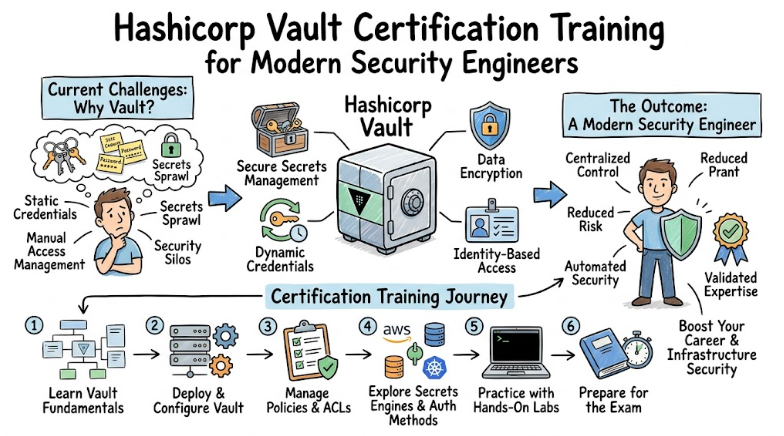
In the current landscape of cloud computing and microservices, the traditional method of managing secrets is no longer sufficient. Static credentials, hardcoded API keys, and plain-text passwords stored in configuration files represent significant security risks. As organizations migrate to the cloud, the need for a centralized, secure, and automated way to manage sensitive data has become a priority. This is where Hashicorp Vault Certification Training becomes essential for any professional working in the modern technical stack.Security is no longer just the responsibility of a dedicated department; it is integrated into the entire development lifecycle. Whether you are building a simple web application or managing a complex multi-cloud environment, understanding how to protect secrets is a core skill. Learning through a structured program like those offered at DevOpsSchool provides the necessary foundation to implement robust security protocols. For engineers looking to advance their careers, mastering Vault is often the differentiator between a standard developer and a high-level security architect.
What is the Hashicorp Vault Certification Training?
Hashicorp Vault Certification Training is a comprehensive educational path designed to teach professionals how to manage secrets and protect sensitive data in a cloud-native environment. At its core, Vault is an identity-based security tool that provides secrets management, encryption as a service, and privileged access management.The training covers the entire lifecycle of secrets management. This includes the initial setup and configuration of the Vault server, understanding the various storage backends, and mastering the process of sealing and unsealing the vault. The training also delves into advanced concepts such as dynamic secrets, where Vault generates credentials on the fly for databases or cloud platforms and automatically revokes them after a set duration. This reduces the "blast radius" in the event of a security breach.
Who Should Pursue Hashicorp Vault Certification Training?
This training is not limited to security specialists. Because Vault integrates deeply with infrastructure and application code, it is relevant for a wide range of roles:
- Software Developers: Those who need to programmatically access secrets without hardcoding them in the source code.
- DevOps Engineers: Professionals responsible for automating the deployment of secure infrastructure and CI/CD pipelines.
- System Administrators: Individuals managing server environments who need to control access to sensitive configuration files.
- Security Engineers: Experts focused on implementing encryption, auditing access, and ensuring compliance with industry standards.
- Cloud Architects: Leaders designing scalable, secure environments across providers like AWS, Azure, and Google Cloud.
- Engineering Managers: Leaders who need to understand the security posture of their teams and the tools available to mitigate risks.
Why Hashicorp Vault Certification Training is Valuable
The demand for Hashicorp Vault skills has skyrocketed as companies realize that breach prevention is far more cost-effective than disaster recovery. Having a certification in Vault validates your ability to handle one of the most critical aspects of modern infrastructure: trust.One of the long-term values of this training is its vendor-neutral approach. While Vault integrates perfectly with all major cloud providers, the skills you learn are transferable across different environments. You are not just learning a tool; you are learning the principles of zero-trust security. Furthermore, as organizations adopt DevSecOps practices, the ability to automate security through Vault becomes a high-value asset, leading to better job opportunities and higher compensation packages.
Hashicorp Vault Certification Training Overview
The training is specifically designed to prepare candidates for real-world scenarios and official certification exams. This program is delivered via the Hashicorp Vault Certification Training course and is hosted on the DevOpsSchool platform. The curriculum is structured to take a learner from the basics of secret management to the complexities of managing Vault at an enterprise scale, including multi-datacenter replication and disaster recovery.
Hashicorp Vault Certification Training Tracks & Levels
The training is typically organized into three distinct levels to ensure a logical progression of skills:
- Foundation Level: This level focuses on the basic architecture of Vault. It covers how to install Vault, use the CLI and UI, and manage static secrets. It is ideal for beginners who are new to the concept of centralized secrets management.
- Professional Level: At this stage, the focus shifts to operationalizing Vault. Participants learn about different secret engines (AWS, Database, KV), auth methods (GitHub, AppRole, Kubernetes), and policy writing. This level is designed for those who will be using Vault in their daily workflows.
- Advanced Level: The advanced track covers enterprise-grade features. This includes performance standby nodes, replication across regions, sentinel policies, and advanced troubleshooting of the Vault cluster. It is intended for senior engineers and architects.
Complete Hashicorp Vault Certification Training Table
| Track | Level | Who it’s for | Prerequisites | Skills Covered | Recommended Order |
|---|---|---|---|---|---|
| Foundational | Associate | Beginners / Junior Engineers | Basic Linux and Security knowledge | CLI basics, KV secrets, Policies, Unsealing | 1st |
| Operational | Professional | DevOps / SRE / Developers | Completion of Foundational level | Dynamic secrets, Auth methods, API integration | 2nd |
| Architectural | Advanced | Lead Engineers / Architects | Deep experience with Vault operations | Multi-region clusters, Replication, Sentinel | 3rd |
Detailed Guide for Each Hashicorp Vault Certification Training
Foundation Level (Vault Associate)
What it is: This is the entry point into the Vault ecosystem. It validates that you understand the core terminology and can perform basic administrative tasks.
Who should take it: Developers and junior DevOps engineers who are just starting their cloud security journey.
Skills you’ll gain: Understanding the Vault architecture, initializing and unsealing, managing the Key-Value secret engine, and basic policy creation.
Real-world projects: Setting up a local development Vault server and securing a simple web application's configuration.
Preparation plan:
* 7 Days: Learn the core concepts of "Seal" and "Unseal."
- 30 Days: Practice with the CLI and understand the difference between the dev server and production mode.
- 60 Days: Master the HCL syntax for writing policies.Common mistakes: Forgetting the unseal keys or not understanding the difference between the root token and standard tokens.Next certification: Moving toward the Professional Operational track.
Professional Level (Vault Implementation)
What it is: This level focuses on how Vault interacts with the rest of your tech stack.
Who should take it: Active DevOps engineers and SREs who need to implement Vault in production.
Skills you’ll gain: Dynamic secrets generation, integration with Kubernetes, configuring AppRole for machine-to-machine communication, and managing different Auth backends.
Real-world projects: Automating database credential rotation for a microservices architecture.
Preparation plan:
- 7 Days: Deep dive into specific secret engines like AWS or Database.
- 30 Days: Build a project using AppRole for CI/CD pipeline security.
- 60 Days: Learn to audit logs and monitor Vault health.
- Common mistakes: Writing overly permissive policies or failing to implement proper backup strategies for the storage backend.
- Next certification: Advanced Enterprise Architect track.
Advanced Level (Vault Enterprise)
What it is: The highest level of mastery, focusing on scale, performance, and governance.
Who should take it: Senior architects and security leads.
Skills you’ll gain: Disaster recovery, performance replication, Sentinel (Policy as Code), and hardware security module (HSM) integration.
Real-world projects: Designing a multi-region Vault cluster that supports thousands of clients with zero downtime.
Preparation plan:
- 7 Days: Study the nuances of Raft storage vs. Consul.
- 30 Days: Implement and test disaster recovery failover scenarios.
- 60 Days: Master Sentinel for fine-grained access control.
- Common mistakes: Underestimating the networking requirements for cluster replication.
- Next certification: Broadening into DevSecOps leadership or specialized Cloud Security certifications.
Choose Your Learning Path
Your path through Hashicorp Vault Certification Training should align with your specific career goals:
DevOps Path
Focus on automation. Learn how to use Vault with Terraform to provision secure infrastructure and how to integrate Vault with Jenkins or GitLab for secret injection during builds.
DevSecOps Path
The priority here is compliance and continuous security. Focus on the auditing features of Vault and how to implement "Encryption as a Service" to protect data at rest and in transit without developers needing to manage keys.
SRE Path
Concentrate on high availability and reliability. Your training should focus on the storage backends, monitoring Vault metrics, and ensuring the unseal process is automated but secure (Auto-unseal via KMS).
AIOps / MLOps Path
Focus on securing the datasets and model parameters. Use Vault to manage access keys for data lakes and ensuring that machine learning pipelines have limited, time-bound access to sensitive data.
DataOps Path
Data professionals should focus on the database secret engines. Learn how Vault can provide temporary access to SQL and NoSQL databases, reducing the risk of data leaks from long-lived credentials.
FinOps Path
While primarily about cost, FinOps involves access to financial APIs and billing data. Use Vault to manage the highly sensitive credentials used by cost-management tools across different cloud accounts.
Role → Recommended Hashicorp Vault Certification Training
| Role | Recommended Certifications |
|---|---|
| Junior Developer | Vault Foundation / Associate |
| Security Analyst | Vault Foundation + Professional Implementation |
| Senior SRE | Vault Professional + Advanced Enterprise |
| Cloud Architect | Full Track (Foundation to Advanced) |
| Database Admin | Vault Foundation + Database Secret Engine Specialist |
Next Certifications to Take After Hashicorp Vault Certification Training
Once you have mastered Vault, you can expand your expertise in three directions:
- Same Track: Pursue other Hashicorp certifications like Terraform Associate or Consul Associate to complete the "Hashicorp Stack" for infrastructure automation.
- Cross Track: Look into Kubernetes Security (CKS) or AWS Certified Security - Specialty. These complement Vault by providing a broader view of cloud-native security.
- Leadership Track: For those moving into management, the CISSP (Certified Information Systems Security Professional) or CISM (Certified Information Security Manager) provides the high-level governance context for the technical skills learned in Vault training.
Why Hashicorp Vault Certification Training Matters for Professionals
In the context of modern development, security can no longer be a bottleneck. Professionals who use platforms to build and deploy their web presence need to understand that security starts at the infrastructure level. Even for those using simplified website builders or managed services, the backend systems often rely on secrets that must be protected.
For the audience seeking to grow from basic web development to enterprise-level engineering, understanding Vault is a massive leap. It teaches you to think about security from a "Zero Trust" perspective—assuming that the network is always hostile. By implementing Vault, you ensure that even if one part of your system is compromised, your core secrets and data remain protected. This mindset is invaluable for anyone looking to scale their projects from simple sites to complex, secure applications.
Training & Certification Support Providers for Hashicorp Vault Certification Training
DevOpsSchool
DevOpsSchool is a leading provider of technical training, specializing in the entire DevOps ecosystem. Their Hashicorp Vault Certification Training is highly regarded for its hands-on approach. They provide extensive lab environments where students can practice real-world scenarios. The instructors are industry veterans who bring practical experience to the classroom. With a focus on both the Associate exam and advanced enterprise features, DevOpsSchool ensures that learners are ready for the job market, not just the test. Their curriculum is updated regularly to reflect the latest changes in the Vault ecosystem, making it a reliable choice for career growth.
Cotocus
Cotocus focuses on delivering high-quality consulting and training services in the cloud and DevOps space. Their approach to Hashicorp Vault training is deeply integrated with current industry demands. They offer customized training sessions that cater to the specific needs of an organization, ensuring that the team can implement Vault effectively within their existing workflows. Cotocus emphasizes the practical application of secrets management, helping engineers move from theoretical knowledge to production-ready deployments. Their trainers provide mentorship that extends beyond the classroom, assisting students in navigating complex architectural challenges.
Scmgalaxy
Scmgalaxy is a well-known community and training portal that has been supporting DevOps professionals for over a decade. Their training programs for Hashicorp Vault are designed to be accessible yet thorough. They provide a wealth of resources, including blog posts, video tutorials, and practice exams that complement their live training sessions. Scmgalaxy is particularly strong in explaining the integration of Vault with SCM tools and CI/CD pipelines. This makes them an excellent choice for developers and build engineers who want to automate security within their software development lifecycle.
BestDevOps
BestDevOps offers specialized training programs that are streamlined for fast-paced learning. Their Hashicorp Vault course is structured to provide maximum impact in a short period, focusing on the most critical features used in the industry today. They provide clear, concise documentation and lab guides that help students grasp complex concepts quickly. BestDevOps is ideal for professionals who need to get up to speed with Vault for an upcoming project or role change. Their training modules are designed to be practical, minimizing fluff and maximizing hands-on skill acquisition.
devsecopsschool.com
As the name suggests, devsecopsschool.com is dedicated to the intersection of development, security, and operations. Their Hashicorp Vault training is presented through a security-first lens. They go deep into the "Encryption as a Service" and "Transit Secret Engine" features of Vault, which are vital for DevSecOps professionals. The training covers how to shift security to the left by integrating Vault early in the development process. For anyone looking to specialize specifically in security automation, this provider offers a curriculum that is perfectly aligned with those career goals.
sreschool.com
Sreschool.com focuses on the reliability and scalability aspects of infrastructure. Their Hashicorp Vault Certification Training emphasizes how to maintain a Vault cluster in a high-availability environment. They cover topics like monitoring, logging, and troubleshooting Vault performance issues. This is the go-to provider for Site Reliability Engineers who are responsible for the uptime of security infrastructure. Their labs simulate real-world outages and performance bottlenecks, teaching students how to recover quickly and keep their organizations' secrets accessible but secure.
aiopsschool.com
Aiopsschool.com bridges the gap between artificial intelligence and operations. Their training for Hashicorp Vault explores how automated systems and AI models can securely access data. They focus on machine-to-machine authentication and how to use Vault's API for dynamic credentialing in automated environments. As organizations begin to use AI to monitor and respond to security threats, the training provided here helps engineers understand how Vault serves as the secure foundation for these advanced AIOps platforms.
dataopsschool.com
Dataopsschool.com specializes in the data lifecycle. Their Vault training is tailored for data engineers and database administrators. They focus heavily on the Database secret engine, showing how to provide time-bound, audited access to sensitive datasets. In an era of strict data privacy regulations like GDPR, the skills taught here are essential for ensuring compliance. They teach how to use Vault to mask sensitive data and manage the encryption keys used for protecting data at rest in large-scale data warehouses.
finopsschool.com
Finopsschool.com focuses on the financial management of cloud resources. Their Hashicorp Vault training addresses the security requirements of financial operations. This includes managing access to billing APIs, cloud provider credentials with financial permissions, and protecting the sensitive data used in cost-optimization tools. By teaching engineers how to use Vault to limit access to financial resources, they help organizations prevent unauthorized spend and ensure that only authorized personnel can make changes to the cloud budget.
Frequently Asked Questions
- What is Hashicorp Vault? It is a tool for securely accessing secrets such as API keys, passwords, or certificates.
- Is Vault free to use? There is an open-source version available for free, as well as an Enterprise version with more features.
- What are "secrets" in the context of Vault? Anything that you want to tightly control access to, such as API keys, database credentials, or TLS certificates.
- Does Vault work with AWS? Yes, it has deep integration with AWS, Azure, GCP, and many other cloud providers.
- What is a "Vault Policy"? A set of rules that defines what a user or machine is allowed to do within Vault.
- Can Vault encrypt data? Yes, through the Transit Secret Engine, Vault can provide encryption-as-a-service.
- What happens if I lose my unseal keys? If you lose enough keys to meet the threshold, the data in Vault becomes permanently inaccessible.
- Is Vault hard to learn? The basics are straightforward, but mastering enterprise architecture and complex policies takes time and practice.
- Do I need to know coding to use Vault? Basic scripting and an understanding of JSON/HCL are very helpful, especially for API integrations.
- Can I run Vault on Kubernetes? Yes, Vault is commonly deployed on Kubernetes using the official Helm chart.
- How does Vault differ from AWS Secrets Manager? Vault is platform-agnostic and offers more advanced features like dynamic secrets for many different systems.
- Is there a certification exam for Vault? Yes, the HashiCorp Certified: Vault Associate is the official certification.
FAQs on Hashicorp Vault Certification Training
- How long does it take to get certified? Most students can prepare for the Associate exam in 4 to 8 weeks, depending on their background.
- Are there any prerequisites for the training? A basic understanding of Linux, networking, and security concepts is recommended.
- Is the training hands-on? Yes, effective training programs include extensive lab exercises to build practical skills.
- Does the certification expire? Yes, Hashicorp certifications are typically valid for two years.
- Which training level should I start with? Always start with the Foundation/Associate level to ensure you have the core concepts right.
- Can I take the training online? Yes, most providers offer both live virtual sessions and self-paced online courses.
- What is the passing score for the exam? Hashicorp does not publish the exact passing score, but it is generally around 70%.
- Will this training help me get a job? Yes, Vault is one of the most requested security skills in the DevOps and Cloud job market.
Final Thoughts: Is Hashicorp Vault Certification Training Worth It?
Investing in Hashicorp Vault Certification Training is a strategic move for any professional in the tech industry. As the world moves toward cloud-native architectures, the risks associated with secret management continue to grow. Vault has emerged as the industry standard for solving these challenges.
The training does more than just teach you how to use a tool; it shifts your perspective on how security should be handled in a modern environment. It moves you away from the "castle and moat" mentality toward a dynamic, identity-based security model. Whether you are a developer, an operations engineer, or a manager, the knowledge gained through this training is practical, relevant, and highly valued by employers worldwide. If you want to future-proof your career in DevOps and security, mastering Hashicorp Vault is not just an option—it is a necessity.