HashiCorp Vault Certification: The Complete Roadmap for Software Engineers & Managers
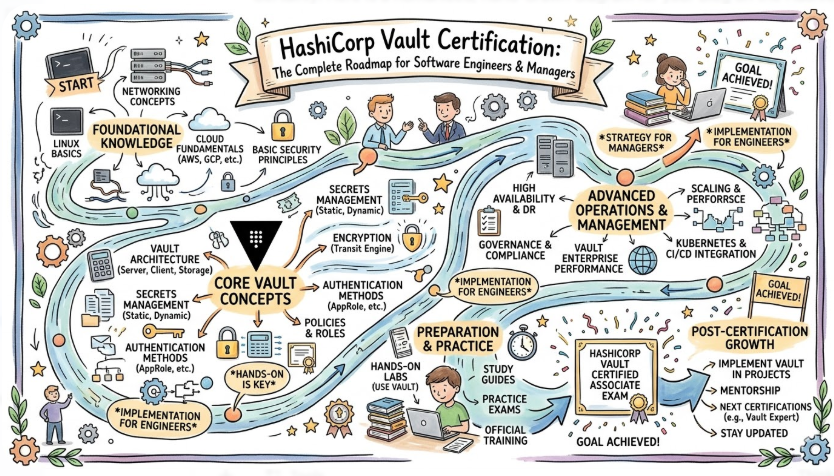
The way we handle security in the digital world has changed forever. In the past, we relied on a strong "perimeter"—a literal or figurative wall around our servers. But today, with cloud platforms and microservices, that wall is gone. Secrets like passwords, API keys, and certificates are everywhere. This problem is called "secret sprawl," and it is one of the biggest risks to any modern business.Hashicorp Vault is the world’s leading solution to this problem. It is not just a place to store passwords; it is a complete system for managing identities and protecting data. For any engineer or manager, understanding Vault is no longer a "bonus" skill—it is a core requirement. This guide will walk you through the Hashicorp Vault Certification journey, helping you move toward a career as a "Zero Trust" expert. It also points the way toward even higher goals, like the Master in Observability Engineering Certifications Program, which helps you manage the health of your entire system.
Certification Overview Table
| Track | Level | Who it’s for | Prerequisites | Skills Covered | Recommended Order | Link |
| Security & Automation | Associate | Engineers & Managers | Basic Linux & Cloud | Secrets, Policies, Tokens, Auth | 1st | Official Certification Link |
Detailed Guide: Hashicorp Vault Certification Training
What it is
The Hashicorp Vault Associate certification is a formal credential that proves you can handle sensitive data in a cloud-native environment. It focuses on the "Associate" level, meaning it covers the core operations and concepts you need for daily work. You will learn how to set up a Vault server, manage how people log in, and create "dynamic" secrets that appear when needed and vanish when they are not. This certification is a signal to the industry that you understand the "Identity-based" security model.
Who should take it
This training is perfect for Software Engineers who want to write more secure code and DevOps Engineers who need to automate security in their pipelines. SREs will benefit by learning how to keep security tools highly available. Even Engineering Managers should take this course to understand how to reduce risk across their teams. If your job involves handling credentials or moving data to the cloud, this is for you.
Skills you’ll gain
This certification transforms you from someone who "uses" security tools into someone who "architects" them. You will gain a deep understanding of how to protect a company’s most valuable assets.
- Advanced Secrets Management: You will learn to move beyond static passwords and use "Dynamic Secrets" for databases and cloud providers.
- Policy as Code: You will learn to use HCL (Hashicorp Configuration Language) to write rules that define exactly who can see what.
- Encryption as a Service: You will gain the skills to provide encryption to your whole team without them needing to manage their own keys.
- Lifecycle Management: You will master the art of token management, including how to create, renew, and revoke access in seconds.
Real-world projects you should be able to do after it
Once you finish your training, you won't just have a certificate; you will have the ability to solve real business problems.
- Building a Secure Pipeline: You will be able to integrate Vault with CI/CD tools like Jenkins or GitLab. This ensures that your automation tools never "leak" passwords in their logs.
- Automated Database Rotation: You can set up a system where every developer gets a unique database password that expires every 4 hours, making it impossible for old passwords to be used in an attack.
- Multi-Cloud Key Management: You will be able to manage keys for AWS, Azure, and Google Cloud from one central, secure location.
Preparation plan
Your path to success depends on how much time you can dedicate each day. Here are three proven paths:
- The 7–14 Day Sprint: This is for engineers who already use Vault at work. Spend 4 hours a day reading the official docs and practicing every CLI command. Take mock exams on day 10 and day 12.
- The 30-Day Professional Path: This is the most popular choice. Spend 1 hour a day. Use the first 15 days for video training and the last 15 days for hands-on labs. Focus heavily on how "Policies" work.
- The 60-Day Deep Dive: If you are new to security, take this path. Spend the first month learning about Linux, APIs, and Cloud basics. Spend the second month focusing specifically on Vault operations and hardening.
Common mistakes
Many people fail because they treat Vault like a regular database. Here is what to avoid:
- Ignoring the "Unseal" Process: People often forget how the "master key" works. If you don't understand how to unseal Vault, you cannot manage it in production.
- Creating "Root" Tokens: A common mistake is using the root token for everything. The exam tests your ability to create "least privilege" policies instead.
- UI-Only Learning: The web interface is easy, but the exam expects you to know the CLI commands. If you don't practice in the terminal, you will struggle.
- Skipping the API: Vault is built to be used by machines. Make sure you understand how the API works, not just the human interface.
Best Next Certification After This
After you earn your Vault Associate badge, you have three powerful options to keep growing:
- Same Track: Look into Hashicorp Terraform Associate. Since most people use Terraform to build their Vault infrastructure, knowing both makes you an "Automation Expert."
- Cross-Track: Move toward the Master in Observability Engineering path. Security tells you if your secrets are safe; Observability tells you if your whole system is actually working and healthy.
- Leadership Path: If you want to move into management, look for certifications in FinOps or SRE Leadership to learn how to manage the costs and people behind these tools.
For a broader look at your options, check out this guide on Top Certifications for Software Engineers.
Choose Your Path: 6 Learning Journeys
Depending on your career goals, Vault will play a different role in your life. Here are the six most common paths:
- DevOps Path: You focus on automation. Your goal is to make sure security is "invisible" to developers by building it into their tools.
- DevSecOps Path: You are the security champion. You focus on compliance, auditing, and making sure the company meets its legal security requirements.
- SRE Path: You focus on reliability. You make sure the Vault server never goes down and can handle thousands of requests per second.
- AIOps/MLOps Path: You use Vault to protect the data used by Artificial Intelligence. You ensure that only the right "models" can access sensitive training data.
- DataOps Path: You focus on data privacy. You use Vault's transit engine to encrypt customer data as it moves through your pipelines.
- FinOps Path: You use Vault’s audit logs to see which teams are using which resources. This helps you track security costs and find ways to save money.
Role → Recommended Certifications Mapping
| If your role is... | Consider these certifications |
| DevOps Engineer | Vault Associate, Terraform, CKA |
| SRE | Vault Associate, Observability Specialist, Terraform |
| Platform Engineer | Vault Associate, Terraform, AWS Solutions Architect |
| Cloud Engineer | Vault Associate, Azure or GCP Professional |
| Security Engineer | Vault Associate, CCSP, DevSecOps Specialist |
| Data Engineer | Vault Associate, Data Analytics Specialist |
| FinOps Practitioner | Vault Associate, FinOps Certified Practitioner |
| Engineering Manager | Vault Associate, Master in Observability |
Top Training Institutions for Hashicorp Vault
Choosing the right school is as important as choosing the right certification. Here are the leaders in the field:
DevOpsSchool This is a top-tier institution for anyone serious about a career in automation. Their Vault training is unique because it is led by people who do this for a living. They don't just read from a book; they show you how to solve the messy, real-world problems that happen in large companies. Their labs are excellent and very practical.
Cotocus This institution focuses on "Expert-level" training. If you are already a senior engineer and you want to dive deep into complex security architectures, Cotocus is the place to go. They specialize in teaching how Vault fits into a "Zero Trust" framework.
Scmgalaxy One of the oldest and most respected names in the DevOps community. They offer a wealth of resources and a community-driven approach to learning. Their Vault training is always up-to-date with the latest features, ensuring you are learning the current version of the tool.
BestDevOps If you prefer a simpler, more human way of learning, this is a great choice. They take very complex technical topics and break them down into easy-to-understand lessons. This is ideal for software developers who might find traditional security courses a bit too dry.
devsecopsschool This school focuses entirely on the "Security" side of DevOps. Their Vault course isn't just about the tool; it’s about the philosophy of "shifting security left." They teach you how to make security a part of the development process from day one.
sreschool For those who care about the "Operations" side of things. Their training focuses on the "Day 2" operations of Vault—things like backups, scaling, and monitoring. If your job is to keep the lights on, this is where you should study.
aiopsschool This institution is at the cutting edge of AI and Operations. They teach how to use Vault to secure the keys and tokens used in automated machine learning environments. It is a very specialized and valuable niche.
dataopsschool Data is the new oil, and this school teaches you how to keep it safe. Their Vault training focuses heavily on the "Transit Engine" and how to protect data at rest and in motion without slowing down your data teams.
finopsschool They focus on the intersection of cloud costs and operations. Their perspective on Vault is unique—they show you how to use Vault's metadata and logs to better understand and manage your cloud security budget.
Focused FAQs: Vault Certification & Career
- Is the Vault Associate exam hard for beginners? It can be. While it is an "Associate" exam, it requires a solid understanding of how servers and networks communicate. It’s not just about clicking buttons.
- How long should I study? Most working professionals need about 30 to 45 days to feel truly confident with the material.
- What are the prerequisites? There are no official requirements, but you should know your way around a Linux terminal and understand how basic IP networking works.
- In what order should I take Hashicorp exams? Most people start with Terraform Associate and then move to Vault Associate, as Terraform is often used to set up Vault.
- Is this certification worth the money? Yes. Companies are desperate for people who can handle security. Being "Vault Certified" often leads to higher-paying roles in SRE and DevSecOps.
- Does it expire? Yes, it is valid for two years. This ensures that you stay current with the latest security best practices.
- Is there a lot of coding involved? Not exactly coding, but you will need to write configuration files in HCL and use the command line (CLI) extensively.
- Can I use this for any cloud? Yes, that is the best part. Vault works the same way on AWS, Azure, and Google Cloud.
- What happens if I fail the exam? You can retake it, but you usually have to pay the fee again. This is why good training is so important.
- Does this lead to a management role? It is a great stepping stone. Understanding security is a requirement for senior leadership in modern tech companies.
- How much does the exam cost? The standard price is $150 USD.
- Is the exam multiple choice? Yes, it consists of multiple-choice and multiple-response questions.
8 General FAQs on Hashicorp Vault Training
1. Why is Hashicorp Vault better than cloud-specific secret managers?
Cloud-specific tools only work on one cloud. Vault works everywhere, which is essential for "Multi-Cloud" strategies.
2. Can I get a job with just this certification?
It is a huge help, but most employers look for a combination of this certificate and actual hands-on experience in a DevOps or SRE role.
3. What is the "Master in Observability Engineering" program? It is a high-level training path that teaches you how to monitor and manage complex systems. It is the perfect "next step" after you master security.
4. Do I need to be a security expert to start?
No. This training starts with the basics and builds your security knowledge from the ground up.
5. Is the training available online?
Yes, most institutions like DevOpsSchool offer both live online classes and self-paced recorded sessions.
6. What is "Dynamic Secrets"?
It is a feature where Vault creates a new password for you on the fly and then deletes it when you are done. This is much safer than "static" passwords.
7. Can I practice Vault for free?
Yes, you can download the open-source version of Vault and run it on your own computer to practice.
8. Which institution is best for beginners?
DevOpsSchool and BestDevOps are generally considered the best starting points because of their clear, simple teaching styles.
Conclusion
Securing a modern company is a heavy responsibility, but it is also one of the most rewarding career paths in technology today. By pursuing the Hashicorp Vault Certification, you are not just learning a tool; you are learning how to build trust into the systems we use every day. Whether you are an engineer looking to protect your code or a manager looking to protect your company, this journey is a vital investment in your future. Remember that security is just one part of the puzzle. Once you have mastered Vault, you should continue your growth by exploring paths like the Master in Observability Engineering Certifications Program. This broader perspective will allow you to see the "full picture" of system health, making you an invaluable asset to any engineering organization. The road to becoming a modern technical leader starts with a single step—start your Vault training today and build the foundation for a resilient, secure career.