Guide to SRE Certified Professional (Training & Certification)
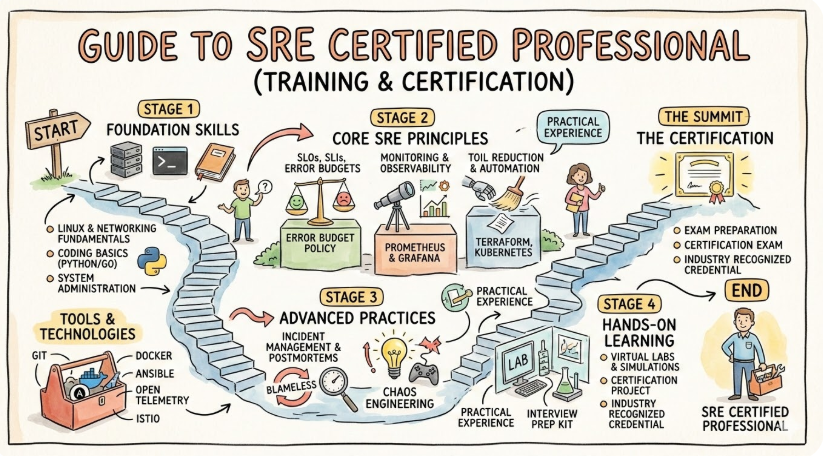
In the early days of software, we had a very simple way of doing things. Developers wrote the code, and operations teams made sure the servers stayed turned on. If something broke, we stayed up all night fixing it, and then we did the same thing again the next week. It was a cycle of fixing fires rather than preventing them. But as the world moved online, this way of working became impossible to maintain.Today, if a major app goes down for even ten minutes, the loss is measured in millions. This is why Site Reliability Engineering (SRE) has become the most important part of the modern tech stack. It isn’t just a new set of tools; it is a way to treat operations like an engineering problem. For those looking to stay relevant in this field, the SRE Certified Professional (Training & Certification) is the most direct path to mastering these skills.
Why This Certification is a Turning Point
Most engineers learn on the job, which is great for small problems but dangerous for large systems. Without a formal structure, you are often just repeating the same mistakes. This course provides that structure. It moves you away from "hoping" the system stays up and gives you a mathematical way to ensure it does. The importance of this training lies in its focus on balance. You learn how to move fast enough to keep the business happy, but slow enough to keep the system stable. This balance is the "secret sauce" of companies like Google and Amazon, and this certification brings that knowledge to your own career.
Breaking Down the Roles: Traditional vs. Modern
To understand where you are going, you have to see where you are standing. Here is a simple breakdown of how the SRE role differs from what we used to do.
| Feature | Old-School Operations | Standard DevOps | SRE Certified Professional |
| Main Goal | High Uptime (No changes) | Fast Delivery | Proven Reliability |
| How Failure is Seen | A disaster to be punished | A learning moment | A metric to be managed |
| Day-to-Day Work | Manual patching | Writing pipelines | Engineering self-healing systems |
| Measurement | "Is it up?" | Deployment speed | SLOs and Error Budgets |
| Problem Solving | Temporary fixes (Band-aids) | Automation of tasks | Redesigning the system |
What You Learn in the SRE Certified Professional Program
This training is not about memorizing definitions. It is about building a toolkit that you can use on Monday morning at your job.
1. The Language of Reliability (SLIs and SLOs)
We used to talk about "five nines" of uptime, but that doesn't mean much if the user is still having a bad experience. In this course, you learn to create Service Level Indicators (SLIs) that actually track what the user feels. You then set Service Level Objectives (SLOs) that tell your team exactly when they need to stop building new features and start fixing the foundation.
2. Managing the Error Budget
Every system will fail. The Error Budget is a way to plan for that failure. It is a shared agreement between the business side and the tech side. If you have a budget for 1 hour of downtime a month and you haven't used any of it, you can take risks. If you’ve used it all, you focus on stability. This removes the constant arguing between developers and ops teams.
3. The War Against Toil
"Toil" is the work that kills an engineer's soul. It is the manual, repetitive stuff that doesn't make the system better. A core part of the SRE Certified Professional (Training & Certification) is learning how to identify toil and use software to eliminate it. The goal is for the system to grow in size without needing more people to run it.
4. Post-Mortems Without Blame
When things go wrong, the instinct is to find someone to blame. SRE teaches the opposite. You learn how to write a "Blameless Post-Mortem" that looks at the process, not the person. This creates a culture where people aren't afraid to admit mistakes, which actually makes the system much safer in the long run.
Why Choose DevOpsSchool as Your Provider?
When you decide to invest in your career, you need to know that the people teaching you actually know what they are doing. DevOpsSchool has been a leader in this space for a long time.They don't just teach from a slide deck. Their approach is built on years of helping large companies fix real-world problems. They understand the challenges faced by engineers in India and across the globe. Their instructors are practitioners who spend their days working on the very systems they teach. DevOpsSchool has built a massive community of professionals, and their certification carries weight in the industry. They focus on the "how-to," ensuring that you leave the course with practical skills you can actually use. You can find all the details about the curriculum and how to join here: SRE Certified Professional (Training & Certification).
The Real Value of This Path
Why should a busy engineer or a manager care about this certification?
- Better Pay: Because this role is hard to fill, companies are willing to pay a premium for people who truly understand SRE principles.
- Peace of Mind: When you build systems that manage themselves, you stop getting called in the middle of the night.
- Global Opportunities: SRE is a global language. A certification from a recognized name like DevOpsSchool opens doors in every major tech hub in the world.
- Leadership Skills: Understanding how to balance risk and reliability is a management skill. This course prepares you to lead larger teams and more complex projects.
Common Mistakes in SRE (And How to Avoid Them)
Transitioning to SRE is not always smooth. Many companies try to take shortcuts, and it almost always ends poorly. The most common mistake is simply renaming an existing team. You cannot take a group of overworked SysAdmins, give them the title "SRE," and expect the system to magically become more reliable.Without a change in how the company works—meaning giving engineers time to actually write code—the "SRE" team will just continue to do the same manual work they were doing before.
- Aiming for 100%: It is too expensive and slows down the business. 99.9% is usually more than enough.
- Tool Overload: Thinking that buying a new monitoring tool will fix a broken culture. Tools only help if you have a plan.
- Ignoring the "S" in SRE: Forgetting that the "S" stands for "Site." The focus should always be on the whole system, not just individual servers.
- Lack of Data: Making decisions based on "gut feeling" instead of the numbers from your SLIs.
- Siloed Teams: Keeping the SREs in a separate room from the developers. They must work together to be successful.
Who Should Sign Up?
If you are wondering if this is the right move for you, consider your current role:
- Software Engineers: If you want to see how your code survives in the real world and learn how to build apps that don't crash.
- DevOps Specialists: If you want to move from "just automation" to "system design and reliability."
- IT Managers: If you need to understand the metrics that drive a successful engineering organization.
- System Admins: If you want to move away from manual tasks and start working as an engineer.
FAQs (Frequently Asked Questions)
Q: Do I need to be an expert in Python or Go to start?
A: You don't need to be an expert, but being comfortable with some basic coding or scripting is very helpful. SRE is about using software to manage systems, so you will be doing some coding.
Q: How long does the certification take?
A: The course is designed to be thorough but flexible. It covers all the core pillars of the SRE framework in a way that fits into a professional schedule.
Q: Is there a lot of math involved?
A: There is some basic math involved in calculating SLOs and Error Budgets, but it is all very practical. You won't be doing calculus; you'll be calculating percentages that help you make better business decisions.
Q: What is the biggest benefit of the DevOpsSchool version of this course?
A: The hands-on labs. You get to practice on real environments, which is the only way to truly learn these concepts.
Conclusion: Taking the Lead
The tech industry is at a point where we can no longer afford to be reactive. The "break and fix" model is dead. To survive and thrive as an engineer or a manager, you have to embrace the principles of reliability engineering.The SRE Certified Professional (Training & Certification) from DevOpsSchool is your roadmap. It gives you the language to talk to the business, the tools to fix the system, and the culture to keep your team happy. It is a transition from being a worker to being an architect of stability.If you are tired of the chaos and ready to build something that lasts, this is your next step. Take the knowledge, get the certification, and start building the future of reliable software.